
Overview
Platelet-rich plasma, or PRP, is prepared from your own blood so a platelet-rich portion can be placed into the scalp. PRP for hair is a listed service at AB Skin Clinic and sits inside a dermatology diagnosis, not as a stand-alone cure. Dr. S. Madhuri separates pattern hair loss, telogen effluvium, and other causes before talking about procedures. Published experience is mixed: some people see thicker hair, others see little change, and methods differ, so no success rate is quoted. PRP does not restore a shiny, fully bald patch or reverse scarring alopecia.
Concerns this visit may address
People book when a partition looks wider, the temples have receded, or the shower drain holds more hair than a year ago. Sudden shedding after illness, childbirth, a crash diet, or fever is a different story from gradual patterned thinning, and both belong in the history. If you have been told you need a transplant, you can still start with a medical opinion. The named hair procedures on the service menu are PRP and GFC for hair. Surgical options, if appropriate, would be discussed only after assessment. This page is not a transplant programme.
Who may benefit from an evaluation
Evaluation is useful when thinning has a pattern, shedding has lasted more than a few weeks, or the diagnosis is unclear. Early pattern hair loss with follicles still visible is the situation most often discussed for PRP, and even then response is unpredictable. PRP is often deferred for active scalp infection, a bleeding disorder, very low platelets, pregnancy, or scarring conditions such as lichen planopilaris. Fully bald skin will not regrow from PRP.
Possible contributing factors
Pattern hair loss follows inherited hormonal sensitivity of follicles, often with a family history and thinning on the crown, partition, or temples. Telogen effluvium shifts many follicles into shedding after fever, surgery, childbirth, rapid weight loss, thyroid imbalance, or low iron. Thyroid and iron status are checked when the history suggests them.
How a dermatologist evaluates the concern
The timeline matters: years of gradual thinning versus weeks of heavy shed. The dermatologist looks for pattern, miniaturised hairs, broken shafts, and shiny scarred patches. A hair-pull test and scalp dermoscopy are often used. Blood tests are requested when thyroid disease, iron deficiency, or another clue is plausible, not as a ritual for everyone. PRP waits if the diagnosis is unclear. Scarring alopecia needs its own treatment. Telogen effluvium may settle as the trigger settles. Medicines for pattern loss may be discussed, with PRP as an adjunct of mixed evidence. See where this sits among hair treatments.
Treatment approaches that may be discussed
The conversation can include treating a scalp condition first, correcting a documented deficiency, topical or oral medicines suited to pattern hair loss, and procedures such as PRP or GFC. If PRP is offered, it is a series of treatments using your own platelets. One sitting is not a full plan. Surgical restoration is not a named programme on the service menu and would be discussed only after assessment.
How the treatment works
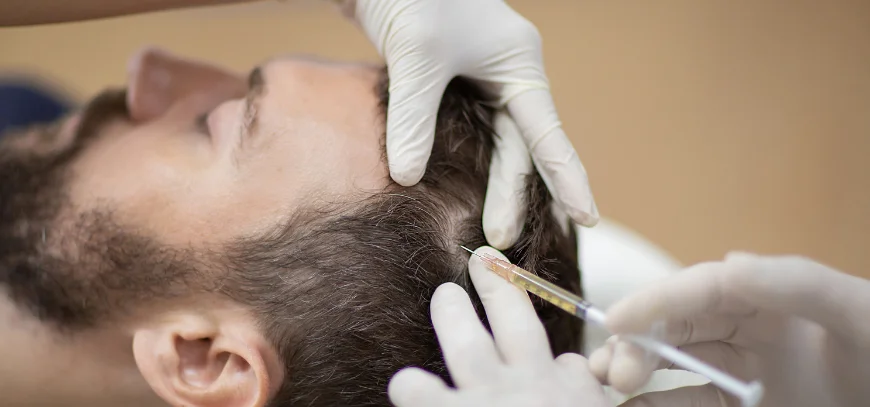
A small volume of blood is drawn, as for a routine test, and processed so a platelet-rich portion is separated. That portion is placed into thinning areas with small injections. The rationale is that platelets release growth factors around follicles that are still alive but miniaturising. Centrifuge settings and doses are individual clinical decisions and are not a home protocol. Sterile technique still matters. Growth-factor signals do not create follicles in scar or in a completely bald scalp.
What happens during a consultation or procedure
Consultation covers history, scalp examination, and a decision about tests or medicines. If you and the dermatologist agree on PRP, consent covers discomfort, bruising, and uncertain regrowth. On the day, blood is drawn, prepared, and injected into mapped scalp. The visit is outpatient. The scalp may look pink for a short time. If a scarring process becomes obvious, the course stops. Book an appointment and note whether shedding or patterned thinning is the main concern.
Preparation guidance
Wash your hair on the day or the night before if you were asked to arrive with a clean scalp. List blood thinners, isotretinoin, and supplements. Mention bleeding disorders, low platelets, infection, and pregnancy. Avoid dye on a sore scalp. Bring earlier blood reports and the names of minoxidil, finasteride, or other products. Hours are Monday to Saturday, 10:00 am–1:00 pm and 6:00 pm–8:30 pm; Sunday is closed. Contact the clinic if you need to postpone.
Aftercare and recovery
Do not wash the scalp until the interval you were given has passed, then use a gentle cleanser. Skip saunas, swimming, and hard workouts for the period advised. Leave small marks alone. Tenderness for a day or two is common. Restart any prescribed topical only on the schedule you were given. Report increasing pain, pus, fever, or swelling that is not settling. Hair cycles are slow, and shedding can continue while a separate telogen process settles.
Risks, limitations, and realistic expectations
Discomfort, swelling, bruising, and faint injection marks are common short-term effects. Infection is uncommon when technique is sterile and the scalp is calm. Evidence for regrowth is mixed and patient-dependent. Some people notice less shed or better coverage; others finish a course without a visible change. PRP is not a cure for scarring alopecia and does not cover a fully bald crown that has no follicles left.
What influences suitability and results
Diagnosis is the strongest influence. Early pattern loss with residual hair differs from a scarred patch or a telogen shed that is already recovering. Your dermatologist may also discuss GFC, a related growth-factor preparation. Neither replaces assessment, and neither has a fixed result.
Why professional dermatology guidance matters
Several causes of hair loss look alike in the shower drain. Starting PRP before someone has looked for scarring disease, infection, or a systemic trigger delays proper care. A dermatologist can also decline a procedure that will not help a bald scarred patch. The clinic’s PRP and GFC hair guide can help you prepare questions.
Why consider AB Skin Clinic
AB Skin Clinic was founded by Dr. S. Madhuri, MBBS, MD DVL, DNB DVL, Fellowship in Dermatosurgery and Lasers, with around ten years in dermatology as stated by the clinic. She is listed as a consultant at Apollo Hospital, Secunderabad, a former assistant professor at ASRAM, and a former senior resident at Siddhartha Medical College. PRP and GFC are the named hair services. Any surgical idea comes only after assessment. You can attend Triveni Towers, MIG-154, 1st floor, Road No. 1, KPHB Colony, Hyderabad 500072, 94949 46701, or Second Floor, Sy No 140, BLOCK-A, Plot No 14, above HDFC Bank ATM, Alkapuri, near Neknampur, Gandipet, Telangana 500089, 98489 99917. Hours are Monday to Saturday, 10:00 am–1:00 pm and 6:00 pm–8:30 pm; Sunday is closed. The clinic states that USFDA-approved lasers are used for laser services.